
Nobody hands their money to an app they do not trust, and on YouTube that trust comes with the creator. For remittance, payment and personal finance apps, the formats that fit are 60-90 second integrations, dedicated videos and Shorts, built on claims your compliance team has approved and judged by verified accounts and first transactions per creator. Brands we’ve worked with include Remitly and AstroPay.
An integration from our network
 Enlarge image
Why YouTube works for fintech
Money decisions need a person, not a banner
Choosing how to send part of your salary home, or which wallet to pay with online, is a decision people think through. They look for someone who has used the product and can tell them it works. A creator who shows the app, the fee and the time it took is that person. For a fintech brand, that is worth more than a hundred impressions nobody remembers.
The product is easier to show than to describe
Exchange rates, fees, verification steps and delivery times sound complicated in text. On screen they are simple: open the app, choose the country, see what arrives. A 60-90 second integration gives the creator time to walk through it, and the viewer sees that it is easier than they feared.
Trust travels with communities
Remittances and digital payments spread by word of mouth inside communities: families split between two countries, freelancers paid in another currency, online shoppers. Spanish-language YouTube is one of the places where those conversations happen, and a creator from the same community speaks with a credibility a brand cannot buy any other way.
Which format fits a finance app
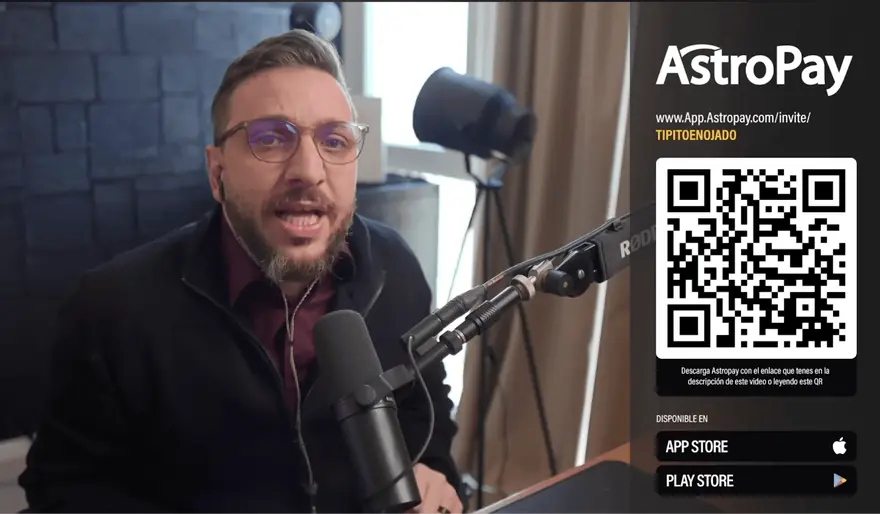
The strongest fintech integrations show a real transfer or payment with the fee on screen, so a 60-90 second integration is usually the foundation. A dedicated video on how to send money to a country or pay online safely suits a launch in a new market. Finance apps are installed on the phone while many people watch YouTube on a TV, so a QR code on screen next to the link in the description is worth adding. The AstroPay integration with Tipito Enojado shown on this page is an example of that.
What fintech brands measure
The first step, but not yet a customer
Unique link or QR per creator, in the brand’s analyticsIdentity checks are a step where users can drop off
The brand’s funnel report, per creatorThe real activation: money moved
The brand’s conversion events, per link and codeWhat each active customer cost
Total cost divided by first transactions, per creatorCustomers who typed the promo code instead of clicking
Personal code per creatorAgree which event counts as a customer before the campaign starts, so the report answers the question your finance team will ask. To size a budget, use the YouTube sponsorship calculator or read what influencer marketing costs, with sourced market prices.
Compliance: what changes when the product is money
Financial messages carry rules other categories do not. We do not give legal advice, and your compliance team has the final word. These are the points worth covering:
- Approved claims only. The brief should carry the list of claims, fees and conditions your team has validated. The creator writes the script in their own voice from it, with no improvised promises about rates, returns or speed, and the brand approves it.
- Clear disclosure. Every integration should be labeled as paid in the video and in the description. In the United States, the FTC Endorsement Guides expect that connection to be clear and hard to miss. In France, the commercial intent must be stated clearly, for example with “publicité” or “collaboration commerciale” (law no. 2023-451, article 5-2).
- Regulated products, extra care. In the UK, the FCA’s FG24/1 guidance (March 2024) explains how financial promotion rules apply on social media and to influencers. In Spain, CNMV Circular 1/2022 covers crypto-asset advertising, including content published by influencers.
- Spain, high-reach creators. Royal Decree 444/2024 sets which creators count as users of special relevance under the General Audiovisual Communication Law: those who, in the previous year, earned €300,000 or more from their activity on video platforms, had 1 million or more followers on one platform or 2 million or more in total, and published 24 or more videos. All three conditions apply together.
- France, a dedicated law. Law no. 2023-451 of June 9, 2023, on commercial influence, bans influencers from promoting certain financial products and crypto-assets, except, for crypto-assets, when the advertiser is approved or authorized under the MiCA regulation (Légifrance, law no. 2023-451, article 4). The AMF and ESMA publish guidance for responsible financial promotion by influencers (AMF).
- Sign-off in writing. It is worth having the brand’s approval of the final talking points in writing before publishing.
These references are a starting point, not a complete list. Rules differ by product and country, and each Latin American country has its own regulator.
What to check before choosing a creator for a fintech
The audience has to have the use case
For a remittance app, look for audiences living away from home or with family abroad. For a payment wallet, people who buy, play or get paid online. We review the audience data the creator shares, not just the subscriber count.
Brand safety is stricter here
Look through the creator’s recent content for get-rich-quick promises, gambling promotions or past sponsors your compliance team would reject. A finance brand cannot sit next to that, and a single bad association costs more than any campaign returns.
Our network is strongest in Spain and Latin America. How a campaign runs, step by step, is on our YouTube sponsorships page.
Result: AstroPay × Tipito Enojado
AstroPay, a digital wallet for online payments, worked with Tipito Enojado and got a ROAS of 20. ROAS is the revenue a campaign brings in for every dollar invested: here, $20 for each $1. See our work.
Fintech brands we’ve worked with


Creators from our network
The network covers tech, travel, lifestyle, food and many other niches.
See all creatorsKeep reading
YouTube sponsorship brief
The brief that gets you a usable first draft, including approved claims.
Get the template MeasurementYouTube sponsorship ROI
How to measure installs and customers per creator.
Read the guide IndustryApps and software
Install campaigns with links, codes and QR codes on screen.
See the sectorFrequently asked questions
Which fintech brands has ICONX worked with?
Brands we’ve worked with include Remitly, for sending money abroad, and AstroPay, a digital wallet for online payments. AstroPay ran an integration with Tipito Enojado, a creator from our network, and got a ROAS of 20.
How do you keep financial messages compliant?
Start from the claims your legal or compliance team has approved and put them in the brief. The creator writes the script in their own voice from that brief, with the disclosures your regulator requires, and the brand approves it before anything is published.
Are creators allowed to promote financial products?
It depends on the product and the country. Payment and remittance apps are generally easier than investments or crypto, which have specific rules: in the UK the FCA’s FG24/1 guidance covers financial promotions on social media; in Spain CNMV Circular 1/2022 covers crypto-asset advertising, including by influencers, and Royal Decree 444/2024 sets which creators count as users of special relevance; in France law no. 2023-451 of June 9, 2023, bans influencers from promoting certain financial products and crypto-assets, except, for crypto-assets, when the advertiser is approved or authorized under the MiCA regulation. In the United States, the FTC expects the paid relationship to be clear. The brand’s compliance team has the final word.
What do fintech brands measure in a YouTube campaign?
Installs, verified accounts, first transactions and cost per acquisition per creator, using unique links, codes or QR codes and the brand’s own analytics. It helps to agree which event counts as a customer before the campaign starts.